
‘One more Unfortunate’: Exploring the Victorian trope of the fallen women in art
- Megan Symonds

- Oct 29, 2021
- 14 min read
Updated: Nov 7, 2021
TW: Suicide
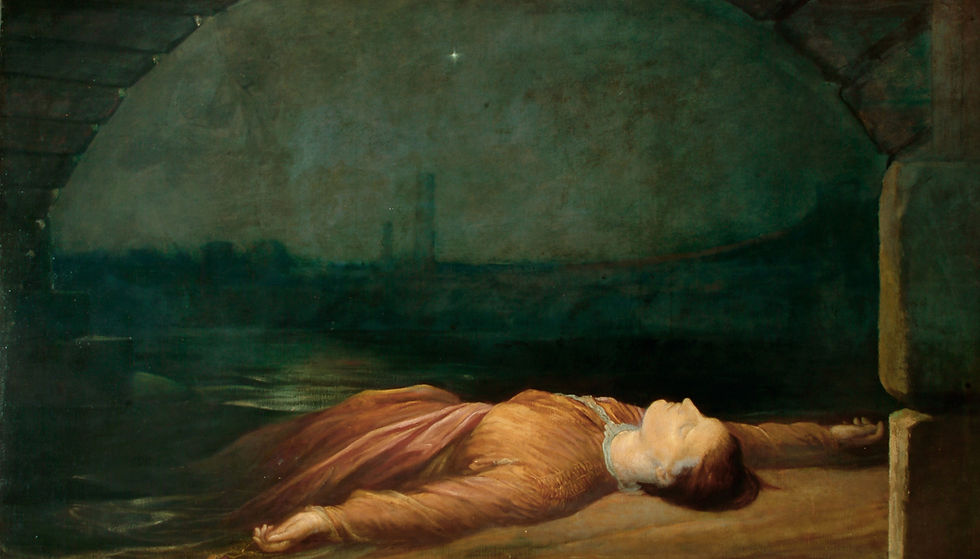
One more Unfortunate, Weary of breath, Rashly importunate, Gone to her death!
This is the first stanza of Thomas Hood’s 1844 poem, The Bridge of Sighs, about the suicide of a homeless woman in London. The poem grew immensely popular and began the Victorian fascination with the character of the ‘fallen women’, who both aroused sympathy and condemnation. In the poem, she is cast out of the home due to her sexual misconduct. From this homelessness she spirals into poverty and resorts to prostitution, and finally in her despair she feels she has no other choice but to take her own life. Much artwork of the second half of the nineteenth century was littered with depictions of such a woman and the critical reactions to them can inform us about the Victorian attitude to gender and sexuality. Did these depictions arouse sympathy, reflect a social concern or can we uncover the moral outrage and ideological prejudice against this character?
The character encompassed a number of female identities, including prostitutes, adulteress women, unchaste women, victims of seduction and even to some extent, lower-class women in poverty.
The trope of the fallen woman was often exhibited at the annual Royal Academy exhibition, meaning that these depictions were often seen by those part of the middle-class and lower middle-class. Newspaper articles expanded the audience for these artworks, reviewing and interpreting the pictures. The convention of the fallen woman is interesting to examine as it is a subject of narrative painting that can be read as particularly moralising. The character encompassed a number of female identities, including prostitutes, adulteress women, unchaste women, victims of seduction and even to some extent, lower-class women in poverty.[4] The fallen woman is both a sympathetic and condemned character. She can certainly inform us a lot about Victorian society’s cultural obsession with the harlot.[5]

Abraham Soloman’s, Drowned! Drowned!, exhibited at the Royal Academy in 1860, features a fallen woman scene inspired by The Bridge of Sighs, with the title of the artwork drawn from Hamlet and its tragic character of Ophelia. In the piece a drowned victim has been pulled from the river, her eyes closed and body limp as she is cradled by another women. Due to The Bridge of Sighs, the audience would have understood that the drowned woman was a prostitute. There are various figures in the scene, each denoting a different subset of Victorian society. The policeman, an authoritative presence, shines a light in the victims face and they are closely surrounded by two watermen and a flower girl, representing the lower class. The figure cradling the victim appears to pity and mourn her. Interestingly, a critic from the Literary Gazette suggested the women sympathized with the victim due to her own ‘pitiful trade’ as a flower girl and called her a ‘fellow creature’.[6] While the language is negative and lacks warmth, it denotes an awareness of the poverty and struggles of lower-class women in society. Victorian London was notoriously hard for the poor, who fought just to make ends meat. The artwork of the period explored the social concern for the prostitute who had previously been treated with contempt and fear.[7] A critic from the Literary Gazette demonstrates this, as they stated ‘this tale of human sorrow and cruelty is but too common; but it is most truthfully and forcibly treated by Mr Solomon. It is full of pathos.’[8] We are treated to the realities of Victorian life, with the plight of the prostitute being a recognisable issue in art, garnering a compassionate reaction from the middle-class audience. In the year 1859 it has been stated the number of prostitutes known to the police in England and Wales was found to be 30,780.[9] Therefore, visitors to the Royal Academy where this work was exhibited, would be aware of the pressing topic of prostitution.
In the artwork, a group of revellers identified as wearing ‘masque costume’ stumble across the scene, soon to be confronted by the body of the drowned woman.[10] A critic of the Athenaeum, analyses the scene:
‘A masquerader, accompanied by a female of unquestionable character… The masquerader looks horrorstruck at the site before him, which we are to suppose is his own handiwork; he strives instinctively to check his female companion, who is advancing on consciousness of the event, and full of feverish life.’[11]
It is interesting that the critic interpreted the masquerader as the catalyst of her fall, engaging her in a sexual affair, and is ‘horrorstruck’ at the result. Another newspaper article also identified the fault of the man, recognising the girl as a ‘victim of his heartless sin.’[12] The critics therefore placed an extent of the blame onto the male in society, his questionable morality does not go unacknowledged or unchallenged. Despite this, the victim is the one that has reaped the consequences of this liaison, as no punishment from the man can be gauged from this scene. Despite the reaction of the masquerader, this piece tells the story through the responses of the women in the scene.[13] The Westminster Review identified the conventional Victorian female behaviour towards prostitution:
‘To act and speak as if unaware of its existence; and many more from genuine delicacy, avert their eyes and resolutely ignore it.’[14]
Interestingly, Solomon has forced the audience to confront the plight of the prostitute, breaking away from societal convention. In the scene, however, the woman’s gaze rests away from the victim, conforming the aversion to and blissful ignorance of the subject. Although, it is implied that the woman in masque costume will soon be aware of the victim’s presence. She is described as ‘full of feverish life’, and her heavy clothes encase her, shawl loosely wrapped around her head.[15] The critic contrasted her strongly with the fallen woman, whose sodden clothes and loose hair frame her ‘pallid face’, evidently absent of life.[16] It is noteworthy that the critic identified the woman in masque costume as ‘a female of unquestionable character’.[17] This indicates the critic believes her to represent the ideal Victorian woman, further staging the dichotomy of the two women. The victim used to encompass the values of the woman but has succumbed to ‘evil behaviour’ resulting in her fall.[18] Nead argued that female sexuality in this period was understood through the central opposition between the virgin and the magdalen, which embodied the fallen woman, controlling the female sexual practice.[19] Therefore, the moral didactic function of this reaction is clear. Victorian women should strive to be respectable and uphold middle-class norms, or the consequence may be ruinous. This middle-class attitude is presented in an article on the dangers of prostitution which states that ‘women… as a rule, shaped their conduct conformably to the views and wishes of men.’[20]
On the other hand, it must be understood that this dichotomy of these two types of women is rather simplistic and ignores more complex issues at play. While critics and artists portrayed these female characters and staged the opposition between them, this is not an indication of the realities of feminine sexuality. Rather, these tropes represent the hypocritical views of the male upper-class. For example, current feminist scholarship transcended this idea of the prostitute and fallen woman as a victim and began to treat her as an active agent, demythologising this character and recognising her as an economic worker.[21] Instead, she is on a path to respectability and marriage, with prostitution acting as a part-time job and therefore a gateway to a moral life in the future.[22] This would suggest a more fluid aspect to female sexuality than critical reactions would suggest. Women did not always fit into societal categories, nor continually followed the cultural ideals set for them. Therefore, while artistic depictions of fallen women were considered revolutionary for their time, turning attention to the plight of prostitution and those facing economic ruin, the art and the critical responses inform us about Victorian ideological biases against such women.
Casteras indicated another female reveller foreshadowed the fallen woman, as a female can be seen flirting with a man, gazing up at him as he leans in to kiss her.[23] As the critic described, she is ‘resisting while challenging him to kiss her’.[24] This indicates that she might be about to give into the promiscuous temptation and the fate of the fallen woman acts as a warning against this. To glean the artistic intention behind the portrayals of these women, Casteras argued these depictions were meant to embolden sympathy from the audience, and views these women as victims of male sexuality.[25] Some sympathy from the critical reception from the Athenaeum can be garnered, as they noted the ‘mournful subject’.[26] On the other hand, he noted how ‘haggard as the girls face is, the remains of beauty would have heightened the pathos of this mournful subject. It does not seem that this unfortunate could ever have been fair.’[27] This statement refers to Hood’s poem, The Bridge of Sighs, where the fallen women’s beauty and appearance were much emphasised.[28] This would suggest that the lack of beauty of the victim in Drowned! Drowned! would have advanced the sorrow and contemplation on the issue of female suicide. Thus, there is more focus on the literature behind the trope and the aesthetic nature of the artwork, than the moralising message itself. This informs us that Victorian female sexuality, even in death, was objectified and seen through the prism of the male gaze, meaning that women are depicted in art from the masculine perspective that sexualises women for male pleasure.
A respectable cautionary tale meant to punish her
This brings in a further point about death bringing about her redemption. As mentioned earlier, in The Bridge of Sighs she is still portrayed as the victim of her situation, but it is interesting that once she has committed suicide she is ‘pure womanly’ again.[29] This implies that to live with her tarnished reputation is a fate worse than death. Nina Auebach argued although the character is viewed with compassion by Victorian contemporaries, she is a product of a culture that fears feminine sexuality and therefore created a respectable cautionary tale meant to punish her.[30] An article on the dangers of prostitution to national health is a reminder of the Victorian’s conflicted mentality of the ramifications of sex workers.[31] Prostitution is noted as having a place in society as ‘an outlet for passions which otherwise might jeopardise the virtue of her own daughters.’[32] Yet despite this, we get a sense of the fear of the profession, stating the ‘social and moral complications are most numerous and inextricable’.[33] This plays into what Nead referred to as ‘Victorians publicly advocating strict codes of chastity, whilst privately endorsing a massive system of prostitution and pornography.’[34] In turn, this is manifested in critical reception of the conventional art, with the critic of the Athenaeum demonstrating his sympathy while also sexualising the victim, representing his conflicting attitudes towards prostitution and the fallen woman. Nead argued that this attempt to cast the prostitute as a victim of seduction rather than an active agent was a mechanism utilised by Victorian society to disarm the fear and threat of prostitution.[35] Hence, in Solomon’s artwork the male anxiety of female sexuality is resolved as the woman is no longer present in the society that she threatens. Her power has been stripped as she has gone from active economic worker to tragic victim.
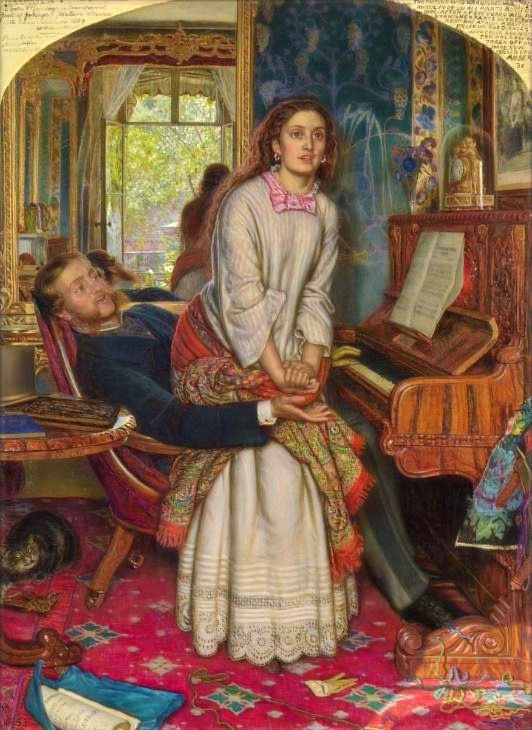
If we examine a more famous artwork of the period, we can analyse William Hunt’s The Awakening Conscience, 1853, which was exhibited at the Royal Academy summer exhibition of 1854. Here, a potential fallen woman is depicted before her demise, yet her fate is foreshadowed. In the image we are treated to a domestic setting, a gentleman sits in an armchair, playing keys on a piano as a woman, identified as his mistress through her lack of wedding ring, sits upon his lap. They have been singing Thomas Moore's Oft in the Stilly Night, but the artist has captured the movement of the mistress as she has begun to rise from her position, a wide-eyed expression on her face.[36] The image is littered with symbolism. We can see a cat toying with a bird under the table, mirroring the couple’s dynamic as, like the bird, she is at his mercy.[37] She can be cast off if she displeases him, and we can understand this implication through the discarded glove on the floor, indicating that her fate if expelled from the house would be prostitution.[38] Yet, there is hope from this scene. As the title would suggest, the woman’s conscience is becoming awakened. She gazes out at the luscious garden the audience can see reflected in the mirror, which Elizabeth Prettejohn argued indicates her possible redemption.[39]
She has foreseen her fate, one which results in prostitution and ruin, although this indicates she might seek to avoid it
The reaction to Hunt’s interpretation of the fallen women can be known through John Ruskin’s letter, Letter to the Times, The Prae-Raphaelites.[40] Ruskin found the audience reception rather disappointing, claiming people had missed the original meaning of the piece and so felt compelled to explain it himself.[41] In fact, in a review in The New Monthly Magazine, an author wrongly identified the lovers in the artwork as brother and sister.[42] Ruskin corrected this, explaining the symbolic elements and stressed its morality. [43] Ruskin identified the fine details, even suggesting the dress the mistress wears, ‘its pure whiteness may be soiled with dust and rain, her outcast feet failing in the street’. [44] Like her dress, she may become tainted. Here, she has even been labelled an ‘outcast’, a fallen woman. Ergo, this all indicates a Victorian attitude towards the prostitute class as a spiralling descent of morality. Nead argued that the suggestion that prostitutes were pitiful debased outcasts was an attempt by society to deconstruct the influence and threat of prostitution.[45] The original face of the women, which was later re-painted, is described by Ruskin as struck by ‘sudden horror… eyes filled with the fearful light of futurity, and with tears of ancient days.’[46] This corroborates Prettejohn’s argument that despite her circumstances, there is hope for her redemption.[47] She has foreseen her fate, one which results in prostitution and ruin, although this indicates she might seek to avoid it. This is a blatant contrast to Soloman’s Found Drowned where the woman has been punished and only found redemption in death. Although in Hunt’s image the threat certainly looms and the women’s agency is not identified, in fact the symbolism implies she has little freedom. The morality stressed by Ruskin can be interpreted as a deterrent for young women to heed the warning of The Awakening Conscience. Rather, this highlights how moral contemplation may serve the feminine soul and redeem her from sin. Arguably this redemption, however, still conforms to patriarchal stereotypes that sought to control women. Even if she changes her path and achieves redemption, she will not regain agency over her sexuality.
The subject of the kept mistress was certainly very topical for the audience viewing this work in the Royal Academy exhibition, as in the nineteenth century divorce had to be acquired through Parliament, with female adultery later becoming key grounds for divorce.[48]The moral outrage of a kept mistress can be understood from further critical reaction of Hunt’s work. A critic of the Athenaeum wrote The Awakening Conscience ‘is drawn from a very dark and repulsive side of modern domestic life.’[49] This informs us that there are indeed living situations such as this in Victorian society, but we can deduce they were deemed taboo by the male middle-class, who wrote for the periodicals. Interestingly, it is not solely the mistress who bears the brunt of the blame. The man playing the piano also receives criticism with the critic writing ‘“fast man” who laughs fiendishly, looks at the spectator with pale face, staring eyes, and clenched teeth.’[50] The description presented to us utilises negative language, suggesting the critics displeasure for the character. They even referred to him as a ‘fast man’ which indicates he is fast and loose with his morals. This implies that, although not to the same degree, Victorian moral condemnation of extra-marital affairs extended to men as well as the fallen woman.
Nead suggested The Awakening Conscience is about bourgeois decency based around marriage and the home, which in this case has been disrupted.[51] The Athenaeum has identified the scene as one of the ‘repulsive side of modern domestic life’, [52] and Ruskin described the furniture as ‘terrible lustre of it, from its fatal newness; nothing there that has the old thoughts of home upon it, or that is even to become a part of home?’[53] Thus, the domestic realm Hunt presents to us is one that subverts cultural norms of Victorian decency. Ruskin has deduced this from the novelty quality of the furniture, suggesting it is a new relationship that lacks the bones of tradition.[54] Flether argued the domestic setting is reminiscent of the family, an economic and social unit, and therefore crucial to Victorian attitudes to gender and sexuality.[55] Fletcher noted that the Industrial Revolution meant there was an increasing separation between public sphere, the traditional masculine economic space, and private sphere, the domestic feminine realm.[56] The home was seen as a women’s sphere, reserved for her morality and femininity, and acted as the nucleus of society from which the public sphere flourished.[57] Nochlin argued women in the nineteenth century were defined by their role as daughter, mother and wife.[58] This would indicate the critic finds the scene of the lovers so shocking as it disrupts marriage, the family, and the Victorian mentality of how men and women should conduct themselves in a domestic setting. Although it must be acknowledged that recent scholarship has contested and dissolved these separate spheres, noting the public roles undertaken by women and men attending to the family in a domestic setting.[59] Yet, the critical reaction informs us that despite this practice, Victorian middle-class mentality was shaped by these gendered realms. We are subsequently presented with the ideological bias against such a character as the fallen women as she alters and potentially destroys the domestic pillar of Victorian identity.
[1] Hood, ‘The Bridge of Sighs’, 414 [2] Pamela M. Fletcher, ‘Virtue, Vice, Gossip, and Sex Narratives of Gender in Victorian and Edwardian Painting’, Dana Arnold and David Peters Corbett (eds.), A Companion to British Art: 1600 to the Present, Hoboken, 2013, 532-551, 532 [3] Ibid., 538 [4] Amanda, Anderson, Tainted Souls and Painted Faces: The Rhetoric of Fallenness in Victorian Culture, Ithaca and London, 1993, 2 [5] Susan P Casteras, Images of Victorian Womenhood in English Art, London, 1987, 131 [6] Critic, ‘The Exhibition of the Royal Academy of Arts’, The Literary Gazette: A Weekly Journal of Literature, Science, and the Fine Arts; 4: 98, London, May 12, 1860, 585-586, 586 [7] Lynn Nead, ‘The Magdalen in Modern Times: The Mythology of the Fallen Woman in Pre-Raphaelite Painting’, Oxford Art Journal, 7: 1, 1984, 26-37, 26 [8] Critic, ‘The Exhibition of the Royal Academy of Arts’, 586 [9] Writer, ‘Art. VI. Prostitution in Relation to the National Health’, John Chapman (ed.), Westminster Review, Jan. 1852-Jan. 1914; 36: 1, Jul 1869, London, 179-234, 184 [10] Critic, ‘Royal Academy’ Athenaeum, 12 May 1860, 33: 1698, 654. [11] Critic, ‘Royal Academy’ 654. [12] Critic, ‘The Exhibition of the Royal Academy of Arts’, 586 [13] Casteras, Images of Victorian Womenhood, 143 [14] Writer, ‘Art. VI. Prostitution in Relation to the National Health’, John Chapman (ed.), Westminster Review, Jan. 1852-Jan. 1914; 36: 1, Jul 1869, London, 179-234, 180 [15] Critic, ‘Royal Academy’ 654 [16] Ibid., 654 [17] Ibid., 654 [18] Hood, ‘The Bridge of Sighs’, 414-17 [19] Nead, ‘The Magdalen in Modern Times’, 26-27 [20] Writer, ‘Art. VI. Prostitution in Relation to the National Health’, 180 [21] Nina Auebach, ‘The Rise of the Fallen Woman’, Nineteenth-Century Fiction, 35: 1, 1980, 29-52, 32 [22] Ibid., 32 [23] Casteras, Images of Victorian Womenhood, 143 [24] Critic, ‘Royal Academy’, 655 [25] Casteras, Images of Victorian Womenhood, 143 [26] Critic, ‘Royal Academy’, 655 [27] Ibid., 655 [28] Hood, ‘The Bridge of Sighs’, 414-17 [29] Ibid., 414 [30] Auebach, ‘The Rise of the Fallen Woman’, 31 [31] Writer, ‘Art. VI. Prostitution in Relation to the National Health’ [32] Writer, ‘Art. VI. Prostitution in Relation to the National Health’, 182 [33] Ibid., 179 [34] Nead, ‘The Magdalen in Modern Times’, 26 [35] Ibid., 31 [36] Tate Britain, William Holman Hunt, The Awakening Conscience, 1853, https://www.tate.org.uk/art/artworks/hunt-the-awakening-conscience-t02075 accessed 31 May 2021 [37] Linda Nochlin, ‘Lost and Found: Once More the Fallen Woman’, The Art Bulletin, 60:1, 1978, 139-153, 145 [38] Tate Britain, William Holman Hunt, accessed 31st May 2021 [39] Elizabeth Prettejohn, The Art of the Pre-Raphaelites, London, 2000, 213 [40] John Ruskin, ‘The Prae-Raphaelites’, The Times, May 25, 1854, London, 21750 [41] Ibid. [42] Critic, ‘Our Annual Peep into the Royal Academy’, Ainsworth, William Harrison (ed.), The New Monthly Magazine, 101: 401, May 1854, 45-55, 49 [43] Ruskin, ‘The Prae-Raphaelites’ [44] Ibid. [45] Nead, ‘The Magdalen in Modern Times’, 31 [46] Ruskin, ‘The Prae-Raphaelites’ [47] Prettejohn, The Art of the Pre-Raphaelites, 213 [48] Fletcher, ‘Virtue, Vice, Gossip, and Sex Narratives of Gender’, 536 [49] Critic, ‘Royal Academy’ The Athenaeum, 1394, London, May 6 1884, 559-561, 561 [50] Ibid., 561 [51] Nead, ‘The Magdalen in Modern Times’, 36 [52] Critic, ‘Royal Academy’, 561 [53] Ruskin, ‘The Prae-Raphaelites’ [54] Ibid. [55] Fletcher, ‘Virtue, Vice, Gossip, and Sex Narratives of Gender’, 535 [56] Ibid., 535 [57] Ibid., 535 [58] Nochlin, ‘Lost and Found’, 140 [59] Fletcher, ‘Virtue, Vice, Gossip, and Sex Narratives of Gender’, 535
Comments